29/3/2007 13:57
Slučajnost... Baš kada sam otvorio blogoye da pišem o koncertnoj nedelji u BG, video sam da sam dobio poziv da budem deo uređivačkog kolegijuma Muzičkog Bloga...

Posle po' godine sam o5 u Beogradu na duže od 2-3 dana. I ono što me je oduševilo je fantastična koncertna ponuda. Jednostavno ne možemo da postignemo da vidimo sve,a baš bismo hteli. Srećom, imamo dobru vezu ne jednom ultra poznatom radiju, pa dosta puta ulazimo za dž. jer smo na kojekavim spiskovima ... Ne pišem ovde o tzv "velikim" koncertima, tipa Peppersa, Maidena, Tošea i sl., nego o malim događajima, koji privuku stotinak ljudi, a ugođaj bude fantastičan.
Ovaj post se se odnosi na prošlu nedelju...
'vako je to počelo ... Nedelja, Bitef. Odvratno mesto, u principu takvi i ljudi. Međutim, koncert Kristala, ulaz naravno preko spiska, što je doprinelo tome da se skupi odlična "ekipa". Nije bilo gužve, a sve ljubitelji Kristala. Moram da dodam, da su oni nekad dosadnjikavi, ali imaju nekoliko vrhunskih pesama.  Koncert odličan, svi pevamo (ja sam ustanovio da znam sve pesme Kristala), jedan bis, drugi bis, publika u delirijumu, Kristali prilično iznenađeni ... Sve u svemu odličan događaj. Pesme Ustani i Kreni, Menjam se, Sasvim sama i  naravno, lični hit Ja imam 2 metra... sigurni ima još neka, ali se ne mogu setiti ...
kristali su bili super, ali ono što se dogodilo u sredu je potpuno izbacilo preovladalo razumom i emocijama...
Sreda, Dom Omladine, Cris & Carla... Daleko poznatiji kao članovi sastava The Walkabouts . Za ovaj koncert smo ipak morali da platimo kartu, 800 din, što je u utorak izgledalo ka problem, međutim u sredu uveče se pokazalo kao jedna od najboljih investicija. JPre koncerta je bila promocija knjige Žikice Simića, svakako jednog od najboljih poznavaoca te muzike (amerikana, folk country, rock, r'n'b) u nas. Knjiga se zove Električna Zavesa.
Ja sam slušao the walkabouts i imao sam neku predstavu kako će sve to zvučati, ali o5 nisam bio skroz sigurna, dok moja devojka nije imala pojma šta je očekuje. Na ulazu smo primetili da smo jedni od najmlađih posetilaca, što dosta dugo nisam doživeo. U Domu Omladine su bile postavljene stolice i tribinica, lepo smo se smestili i C&C su počeli... Od prvih taktova se osetilo da će biti nešto posebno. Prvo se osetila neverovatna navala emocija, prvo prema devojci, a uskoro su mi falili skoro svi koje sam ikada poznavao. Poželo sam da se svi ljudi koje poznajem pojave tu i da se sa svima izgrlim, a da se to isto vreme neprestano grlim i sa devojkom... Neverovatno je bilo. Videlo se i po drugima da se tako osećaju. "Kao da znaju neki ton koji direktno pogađa u centar za emocije" reče moja devojka ... Njih dvoje su genijalni. Dve gitare, dva vokala, u nekim pesmama sintisajzer "od $8" ...
to je bila sreda... koncert koji će jako dugo ostati u pamćenju...
Sledeći dan , nešto potpuno drugačije
Četvrtak, Studenjak, Horkestar (bivši Horkeškart) Potpuna suprotnost po emociji od srede. Hor sastavljen od 30ak ljudi + 2 gitare+bas + bubanj. Svirači su odlični, hor savršeno uvežban. Izbor i textovi pesama su takvi da se publika zabavlja i smeje, ali istovremeno i da se pokaže da je HS postao ozbiljna muzička tvorevina. Uglavnom pevaju obrade, ali su one toliko obrađene da bi se teško prepoznao original da ga ne najave pre pesme (i to sa megafonom). Pesme su u rasponu od Jedem ti malter i Kako čeka u šolji mleka do političke Nazad. Meni se lično najviše sviđa obrada (čini mi se Obojenog programa) Hvala. Nema šanse da vam ovaj hor ne izmami makar smeh, ako ne i potpuno oduševljene ovim mladim ljudima. U stvari, bio je jedan pojedinac kome se nije svidelo sve to, ali on je poznat kao gunđalo i njemu je sranje sve što voli više od 20ak ljudi...
U petak smo ipak malo odmarali i bili prinuđeni da propustimo nastup fantastičnih The Singing Lions.
Odmor je bio gotov već sledećeg dana...
Subota, SKC, Zion Train   
kao što mu i ime kaže, radi se o reggae-dub bendu koji čine crnja za gramofonima i kompom (koji radi kao mašina, toliko dobro i toliko emotivno, nasmejao se tek na pred kraj koncerta), matori MC (ne objektivno mator, nego mator za reggae MCa) koji ima retko veliku količinu energije, koja jednostavno izbija iz njega i vuče ceo SKC , zatim truba i trombon. Vrlo interesantna postava, koje se okreče oko DJ-a i energije MC-a ... pardon, u reggae ne postoji DJ nego Selektah ... Čovek, skače, luduje po bini, svaki čas animira masu, vrhunski pro i vidi se da ima ogromno iskustvo u komunikaciji sa publikom. Bilo je jako zabavno gledati ga i slušati, i nije bilo šanse (ako je neko uopšte i pokuavao) odupreti se tom ritmu i toj eneregiji i ne đuskati ... Ono što je meni bilo super je to što je pevač izašao na binu u trenerci ... Sve u svemu, koncert vredan pažnje ...
objavio: Lezilebovich kategorija:
obavesti prijatelja | Komentara (0) | Pošalji komentar
23/3/2007 12:23
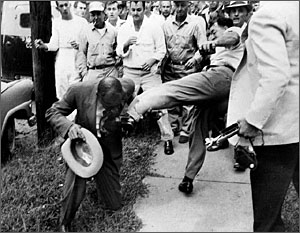
Ovo jeste stara vest, ali ovakvih vesti ima mnogo , a zahvaljujući  ovome  sam se setio ...

The Little Rock Nine or the Little Rock Crisis refers to an incident in which nine African-AmericanLittle Rock Central High, in the southern state of Arkansas in 1957 during the Civil Rights Movement. students were prevented from attending


September, 1949 University of Arkansas School of Law is integrated.

January, 1951 Little Rock Public Library board approves integrating its facilities.

May 17, 1954 The U.S. Supreme Court rules racial segregation in the public schools is unconstitutional in Brown V. Board of Education of Topeka, Kansas.

May 22, 1954 The Little Rock School Board issues a policy statement saying it will comply with the Supreme Court's decision when the Court outlines the method to be followed and the time to be allowed.

May 24, 1955 The School Board votes unanimously to adopt Superintendent Virgil Blossom's plan of gradual integration that would start in September, 1957, at the high school level and add the lower grades over the next six years. Mr. Blossom is named "Man of the Year" by the Arkansas Democrat for his work on desegregation.

January 23, 1956 Twenty-seven black students attempt to register in all-white Little Rock schools, but are turned down.

February 8, 1956 The NAACP files suit on behalf of 33 black children denied admittance to four white schools.

August 28, 1956 Federal Judge John E. Miller dismisses the NAACP suit, declaring the Little Rock School Board had acted in "utmost good faith" in its integration plan. The NAACP files an appeal.

Fall, 1956 The city's public buses quietly are desegregated with no problems.

April 29, 1957 The Eighth Circuit Court of Appeals in St. Louis upholds Judge Miller's dismissal.

Spring, 1957 There were 517 black students who lived in the Central High district and were eligible to attend Central in the fall. Eighty expressed an interest in doing so. Following interviews with the Superintendent and staff, 17 are selected for the first year of integration at Central. Eight of those later decide to remain at all-black Horace Mann High School.

Summer, 1957 With desegregation scheduled for September, opponents organize the Capital Citizens Council and the Mother's League of Central High School.

August 27, 1957 A member of the Mother's League files a motion seeking a temporary injunction against school integration. Pulaski County Chancellor Murray Reed grants the injunction "on the grounds that integration could lead to violence."

August 30, 1957 Federal District Judge Ronald Davies nullifies the injunction.

September 2, 1957 Governor Orval Faubus calls out the Arkansas National Guard to surround Little Rock Central High School to preserve the peace and avert violence that may be caused by extremists who came to Little Rock "in caravans."

September 3, 1957 Judge Davies orders desegregation to start the next day.

September 4, 1957 The nine black students attempt to enter Central High but are turned away by the National Guard.

September 9, 1957 The Council of Church Women issues a statement opposing segregation and deploring the Governor's calling out the guard. It calls for a citywide prayer service for September 12.

September 20, 1957 Judge Davies rules that Faubus had used the troops to prevent integration, not to preserve law and order as he claimed. The Governor removes the Guardsmen and the Little Rock Police Department takes over.

September 23, 1957 As a crowd of 1,000 mills around in front of the school, the nine black students go inside through a side door. A white student takes them to the principal's office where they are to receive their class assignments. When the mob learns the students are inside, it becomes unruly and the police fear they will be unable to maintain control. The black students are taken out of the school through a side door.

September 24, 1957 Little Rock Mayor Woodrow Mann sends President Eisenhower a telegram asking for federal troops to maintain order and complete the integration process. The President announces he is sending 1,000 members of the 101st Airborne Division to Little Rock. He federalizes the 10,000-man Arkansas National Guard.

September 25, 1957 Under escort by the Army troops, the nine black students are escorted back into Central High.

October 3, 1957 Georgia Dortch and Jane Emery, editors of Central High's student newspaper The Tiger, editorialize: "Looking back on this year will probably be with regret that integration could not have been accomplished peacefully, without incident, without publicity." The editors encourage "each individual to maintain a sensible, peaceful neutrality; to accept the situation without demonstration, no matter what personal views are entertained; and to make these, your years in Little Rock Central High School, the happiest and most fruitful of your academic education."

October 17, 1957 A Mother's League petition to remove the federal troops who are there in violation of state and federal constitutions is dismissed by Judge Davies.

December, 1957 Taunted by white male students, Minnijean Brown, one of the black students, dumps a bowl of chili on her antagonists in the cafeteria. She is suspended for six days.

February 6, 1958 Following additional altercations with white students, Minnijean Brown is suspended by the Board of Education for the remainder of the school year. She transferred to New Lincoln High School in New York City.

February 20, 1958 The Little Rock School Board files a request for permission to delay integration until the concept of "all deliberate speed" is defined and until effective legal means exists for integrating the schools without impairing the quality of the educational programs.

May 1, 1958 Central Principal Jess W. Matthews writes to the Seniors of 1958 in the school yearbook, "The graduating Class of 1958 will always stand out in my memory because...the class as a whole reacted so admirably to the shock of having the eyes of the world focused on the school...and the class united in a very cooperative way to leave a fine record of achievement in Central in a year that will no doubt be mentioned in history books for a long time to come."

May 27, 1958 Ernest Green becomes the first black student to graduate from Central High as he joins 600 senior classmates in commencement ceremonies at Quigley Stadium. Federal troops and city police are on hand but the event goes perfectly.

June 21, 1957 Federal District Judge Harry Lemley grants the delay of integration until January, 1961, stating that while black students have a constitutional right to attend white schools, the "time has not come for them to enjoy that right." The NAACP appeals.

August 18, 1958 The Eighth Circuit Court of Appeals in St. Louis reverses the Lemley delay order.

August 21, 1958 The School Board requests the Appeals Court to stay the order overturning Judge Lemley's decision for 30 days to allow the board time to appeal to the Supreme Court.

August 25, 1958 The U.S. Supreme Court announces a special session to discuss the Little Rock school desegregation issue.

August, 1958 Governor Faubus calls a special session of the state legislature to pass a law allowing him to close public schools to avoid integration and to lease the closed schools to private school corporations.

September 12, 1958 The Supreme Court rules that Little Rock must continue with its integration plan. The School Board announces the opening of the city's high schools on September 15. Governor Faubus orders Little Rock's three high schools closed.

September 16, 1958 The Women's Emergency Committee to Open Our Schools is formed and asks for a special election as a way to keep the schools open.

September 27, 1958 Voters overwhelmingly oppose integration by a vote of 7,561 for and 129,470 against.

September, 1958 Public high schools in Little Rock close for the year, sending the city's 3,698 high school students to seek alternatives. More than 750 whites enroll in newly established private T.J. Raney High School. Others leave town or the state to live with friends or relatives to continue their education.

November 12, 1958 Five of the six members of the Little Rock School Board resign in frustration, having been ordered by a federal appeals court to proceed with integration of the high schools, even though it had no high schools to integrate.

December 6, 1958 A new school board was elected with its membership evenly divided between those favoring compliance and those favoring resistance to the court's orders.

March, 1959 Little Rock Chamber of Commerce votes 819 to 245 in favor of reopening the schools on a controlled minimum plan of integration acceptable to the federal courts.

May 5, 1959 Segregationist members of the School Board attempt to fire 44 teachers and administrators suspected of integrationist sympathies. The three moderates on the board walked out, refusing to participate.

May 8, 1959 Stop This Outrageous Purge, or STOP, and the Women's Emergency Committee are formed to recall the segregationist members of the board. On the other side, segregationists form Committee to Retain Our Segregated Schools (CROSS).

May 25, 1959 STOP wins the recall election by a narrow margin and the three segregationists are replaced by moderates on the School Board.

June 18, 1959 Federal court declared the state's school-closing law unconstitutional. The new school board announced it would reopen the high schools in the fall.

August 12, 1959 School board opens public high schools a month early. Three black girls quietly attend the new Hall High School in the upper income all-white area of west Little Rock with no fanfare. Governor Faubus addresses a segregationist rally at the state Capitol and guardedly advised them against any "rambunctious protest." Carrying American flags, about 250 people then marched to Central High to protest. This time Little Rock police take the offensive, quickly arresting 21 and calling in fire hoses to be turned on the remaining crowd, which dispersed. Jefferson Thomas and Carlotta Walls, two of the original Little Rock Nine, return to Central for their senior year.

Fall, 1972 All grades in Little Rock public schools are finally integrated.

September 28, 1977 At the 20th anniversary of the desegregation crisis, Ralph G. Brodie, the '57-58 student body president, spoke a special occasion at Central where he paid tribute to the "moderate, quiet voices" who urged compliance with the law and an end to the crisis that eventually closed the four high schools at Little Rock for a year. He said only a small group of Little Rock residents were responsible for the city's bigoted, violent and prejudiced image, adding, "But for most of us, that image remains entirely undeserved." He addressed three of the Little Rock Nine who were present: "You've done much to assure the rights of others. Yours were acts of courage, and I salute you."

October 24, 1987 Thirty years after first entering Central High, the Little Rock Nine returned as a group for the first time. They were met by Lottie Shackelford, Little Rock's second black mayor. Central High cheerleaders and other students-black and white-broke into applause. Melba Pattillo Beals said, "What we feel this morning is joyous that we made it, and sad that we had to make it." Benjamin L. Hooks, NAACP executive director, said, "We don't come to open old wounds, but rather to celebrate and commemorate the great moment in history that changed the course of this nation and changed it for the better."


objavio: Lezilebovich kategorija:
obavesti prijatelja | Komentara (25) | Pošalji komentar
20/3/2007 11:34
Posle pročitane vesti da u Nemačkoj brat i sestra imaju četvoro dece (od kojih su ima troje odzeli) dosta sam razmiljao ovoj temi (dosta =više od 5 minuta). Izvor

Uopšte nemam dileme prema odnosu roditelj-dete, to je svakako za najtežu krivičnu osudu. Međutim situacija je bitno drugačija u slučaju brat-sestra (i ostale kombinacije). Velika većina (uključujući i mene) na pominjanje ovakvog odnosa napravi onu gadljivu facu. Možda nam padnu na pamet naši najbliži i shvatimo koliko je takav odnos nemoguć iz naše perspektive.
Dve stvari su bitne oko ovakvog odnosa. Prvo je prihvatanje samog odnosa i drugo je posledice takvog odnosa - tj. deca.
Prva stvar je koliko toliko jasna. Te dve osobe su odrasle individue koje žele da se heftaju međusobno. Tu ni zakon ne traži ništa. Većina nas se gadi, ali ako vi to želite, vi se tucajte. Pročitao sam negde da se "aseksualna" osećanja prema bratu/sestri intenzivno razvijaju do 5,6 godine. Ono dvoje junaka prvog reda nisu znali za postojanje ovog drugog do svojih dvadesetih godina. I onda su se upoznali, naravno bili su slični i ljubav se razvila. Nekako, nije to ni toliko čudno. Normalno je da se ljudi zaljubljuju u slične osobe. Oni jednostavno nisu imali prilike da razvoju bratskosestrinske odnose. Ja gledam svoj suprotan primer. Imam blisku sestru od ujaka. Ali je nisam video 15 godina. I sama činjenica da mi je ona sestra, mene ne može naterati da imam bilo kakva osećanja prema njoj. verovatno važi i u suprotnom smeru. To što su njemu rekli da mu je ona sestra, nije moglo da promeni činjenicu da se on zaljubio. I to je nekako u redu.
Problem naravno nastaje sa mogućnošću da imaju decu. Na prvi pogled 99% nas će reći, ma kakva crna deca, oni su bolesni i ne treba im davati decu. Možda. Možda i ne.
Verovatno najozbiljnija prepreka je mogućnost da se dete rodi retardirano. Ovaj par je ba dobar primer jer su uboli verovatnoću koja je 50%. Dvoje dece normalno, dvoje nije. Ako bi zabranili njima da imaju decu, da li bi po istoj logici trebali zabraniti i retardiranim ljudima da imaju decu. I njihova deca će se verovatno roditi retardirana. A ako se eventualna zabrana samo bazira na hendikepu dokle može da ide zabranjivanje ? Da na kraju samo lepi i visoki, sa IQ>118 imaju decu ?
+ ako je dozvoljeno da imaju odnose, teko se može sprečiti da nemaju decu. Da ih onda šalju u zatvor?  + da li može postojati dilema tipa da li je za dete bolje da se rodi sa hendikepom nego da se ne rodi uopšte ?
+ da li su hendikepirana deca nužno nesrećna ? ne verujem.

Da mene pitaju za konačno rešenje,ne znam šta bih im odgovorio.
objavio: Lezilebovich kategorija:
obavesti prijatelja | Komentara (19) | Pošalji komentar
13/3/2007 13:17
Ponedeljak.
Divno jutro. Peščana staza.
Tvoja dva oka me prate svuda.
Oba u levom džepu.
objavio: Lezilebovich kategorija:
obavesti prijatelja | Komentara (4) | Pošalji komentar